WELCOME!

Welcome to Through the Slant a blog offering perspective of the world from the the eyes of an aspiring pseudo sociologist who often believes that he is either too Asian or not Asian enough. If you enjoy my blog, become a follower don't be shy.
Showing posts with label math. Show all posts

Saturday, July 11, 2009

Stuff We Rike #9 Math


Yes, it's true, Asians really like math.

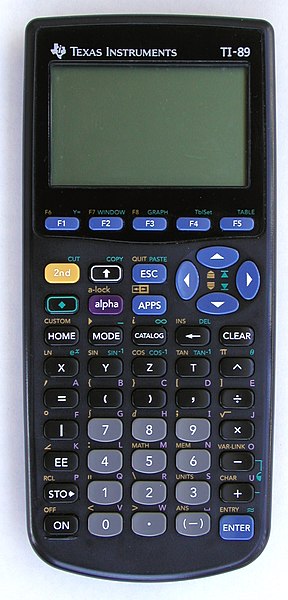
Although education is held in high regard by every Asian, there is a special place in the heart of Asians for arithmetic. Being Asian can mean a lot of things and encompasses people from many geographical and cultural backgrounds but undoubtedly being Asian means liking and appreciating math. The harder the math, the more likable it gets. From abacuses to TI-89 graphing calculators, from SOACAHTOA to limits, math is the glue that bonds countless Asians together. Just think, how many Asian students have you ever seen not have at least a TI-83 calculator if not the TI-89 plus; Asians are even less likely to have the Casio version of a graphing calculator. When it comes to math, Asians mean business. In fact it has been scientifically proven that there is a positive correlation between being an Asian mother and liking math. The higher you register on the Asian mother scale the more likely you’re going to are going to appreciate imaginary numbers.

Nobody loves math more than the vanguard of Asian familie
s, first generation Asian mothers. They may have no idea what their children are reading in school, but they know that if your homework assignment has numbers on it, it is of utmost importance. Ernest Hemmingway and Maya Angelou play second fiddle to Pythagoras in the Asian mother hierarchy of important people. In fact they like numbers so much, they cannot even fathom the letter grading system. In the perfect Asian world, grades would extend out to three decimal places if not more. A D- in phys ed? No big deal in the Asian household. An A- in math? Three cane lashings and being locked in a room with a graphing calculator, flash cards, and an abacus for the next few days.


Asian appreciation and general success at the four letter dread, math, has been attributed to many things from genetics, parenting, intense peer pressure, to being beat if they suck at math. The details and scientific research of this Asian phenomenon has spanned many research projects and grad school write ups and is best left to those who are much smarter than I am. I just know that math and Asians are tied at the hip. If you're Asian you either take pride in being good at math and Asian or take pride in the fact that you're Asian and not good at math; either way as an Asian you are measuring your Asian with your ability to perform derivatives.

The Immigration Act of 1965 or the Hart-Cellar Act greatly redefined the way immigrants came into the United States by expanding the number of people who could arrive on American soil from the eastern hemisphere. It was a landmark piece of legislation for many reasons but it is mainly known as the infamous day in history when grading curves in math classes were severely affected for non Asians for the rest of eternity. This day marked the day Ivy league schools and advanced placement high schools around the nation had to install English as a second language centers and classes up next to their engineering departments and calculus classrooms. A watershed moment in Asian American history indeed.

In short, we're Asian. We like numbers better than letters, unless those letters are being used to represent numbers.

Read more...

Sunday, July 5, 2009

Stuff We Rike #8 Repetitive Activities


Throughout the course of time, Asians have developed a reputation for excellence in certain endeavors and have even been coined, "model minorities," earning their white stamps of approval. If you were to explore the activities that Asians excel at in greater detail you will soon come to realize that these activities all have one thing in common, they require an immense amount of repetition. In fact Asians love repeating things. There is a magnetic pull that draws Asians to things that require countless hours of tedious repetition. We are serious believers in if you ever fail, try, try again until you succeed; otherwise you are just an Asian failure.

There is an unfair assumption that claims that Asians are really bland. I have to wholeheartedly disagree with that notion. Asians just really like to do stuff over and over and over again. They choose to engage in activities that can be mastered through the rinse and repeat method and will practice this activity until they reach a level of accomplishment they deem to be sufficient; which for most Asians means better than most people. Before Malcolm Gladwell popularized the 10,000 hour rule, in his book "Outliers," which states that : in order to become an expert in your field you must practice that activity for a minimum of 10,000 hours, Asians had another term for the rule; having Asian parents.

The variety of activities that Asians choose to practice over and over again cover a huge gamut of disciplines including athletics, music, academics and video games just to name a few. When choosing which activities to partake in, Asians traditionally steer themselves and their children towards activities that require the greatest amounts of focused repetition and the least amount of free thinking improvisation and creativity. The 456,237 to 1 Asian piano player to Asian saxophonist ratio clearly highlights the Asian desire to practice repetition over improvisation.

Even when you venture into the world of sports and the vast number of sports available for people to participate in you can see the concentration of Asian athletes are clustered towards sports that indeed require tons of repetition. Asians do not excel at sports such as basketball and soccer that require plenty of improvisation and on the fly decision making. Instead Asians are masters of synchronized diving, ping-pong, gymnastics and figure skating. I mean did you not see the introduction to the Beijing Olympics? Try getting that many people who are not Asian to do the same thing for three hours. Asians do not like to leave things to chance, when they can instead practice the tiniest of details over and over again and excel. The more variables involved in a sport, the less likely an Asian will participate. Think about it, that's probably why you've never seen an Asian freestyle wrestler. There are way too many possible holds, submissions and angles in freestyle wrestling. That's why Asians have sumo wrestling where you just push the other dude out of a circle over and over again.

Do not get me wrong though. Although Asians choose to choose simple repetitive sports to participate in, Asians are not only drawn to simple activities. This is simply not true. In fact Asians take even GREATER pride in mastering complex repetitive activities. Why do you think that Asians love to be good at math, Dance Dance Revolution and World of Warcraft? Do not be fooled. Asians are not inherently good at any of those previous three things. They just practice these activities with such zeal and secretiveness that it creates the illusion of being a character trait of Asians. Asians aren't better than anybody else at math or rhythmic dancing games, they are just better at repeating things and staying the course until they get it. So when the Asian kid who's been using his abacus since age two is better at the multiplication table than you or when the Asian gamer gets his World of Warcraft character to level 60 before you do, just know that it's not your fault, Asians are really good at repeating things.

Asians don't believe in practice make perfect. There would be nothing left to practice if perfect were ever reached. They do believe in practice makes you better than other people and to most Asians, that's all that matters.

Read more...

Monday, April 20, 2009

Stuff We Rike #3 Complexity


"Life is really simple, but we insist on making it complicated."
-Confucius

The list of figures whose wisdom have permeated to the present is a short list and Confucius is one of the few figures who have withstood the test of time and made the "their axioms will have credibility until the end of time," shortlist. You may be wondering how this quote pertains to what Asians like but let me assure you it does.

The collective "we" that Confucius is referring to are Asians. Asians have shown the collective ability to take any simple situation and make it about 376.41% more complex than it should be. Now why 376% more complex? Because 376% would just be too simple a figure. Do not get me wrong however, this does not mean that Asians cannot operate in complex situations; they actually thrive in such situations. In fact Asians take immense pride in the complexity that they surround their everyday lives with. In fact if Confucius says so, it must be true. Let's examine this phenomenon a little more in depth.

LANGUAGE

One of the easiest places to see how Asians choose complexity over simplicity is in how they communicate. From the earliest days of writing where symbols and pictograms were used to convey information to today's modern forms of communication, language and particularly the written language has gone through an immense amount of simplification. Most written languages throughout the world share similar beginnings with pictorial representations and a few Rosetta Stones and modifications later arrive at an alphabet system to make things simpler.

Asians, and more specifically the Chinese, however, have chosen to not only choose not to simplify their written language with an alphabet but have stuck with using one character to represent one idea. This is the Chinese character for "I": 我. Seriously. And you wonder why Chinese is so hard to learn? Because it is complex. Asians love that their languages are insanley hard to understand and learn and take pride in the fact that their languages are hard to decipher; we like to be a complicated bunch.

Entertainment

People like to do enjoyable things and engage in activities to entertain themselves themselves for the sake of fun. One of the most time tested of these activities is checkers; easy to learn, difficult to master. Traditional checkers takes place on an 8x8 board that has alternating squares where pieces can only move in two directions. We all know the game. We have all played it at some point in our lives.

Now what happens when you cross checkers with Asians? You get Chinese checkers. Let's take the game of checkers, find out how we can increase its complexity and then we can call it an Asian parlor game. The thought process going into creating Chinese checkers mus have gone something like this: A square board? Too simple. Oh let's make the board a hexagram instead. Two sets of pieces? Too simple. Oh let's actually make six sets of pieces. 64 squares? Again too simple. Let's make 121 indentations instead. I guess if If we allow the pieces to still jump we can still call it checkers. Whallah! I present you Chinese Checkers!

EATING

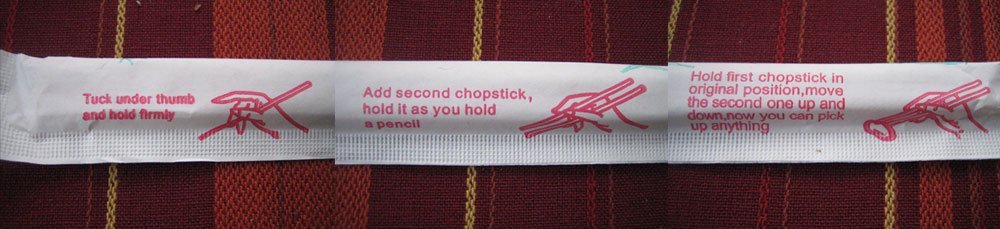
Food and the need of it is one of the few human necessities. How Asians choose to eat their food is another way that Asians choose to over complicate their lives. I am going to reiterate once againthat everybody needs to eat. Food is a must. You would think that you would like to consume food in the simplest manner possible. Asians disagree. In fact most Asians choose to eat their food by using two rounded sticks to pick things up. Some may be saying that they know how to use chopsticks and that they are highly efficient. I answer you this. Do you take pride in being able to use any other eating utensil? Have you ever heard anybody gleefully state, "Yes! I can use a spoon!" Probably not. And lastly, what other eating utensil comes prepackaged with instructions.


Math

Asians like math. They prefer complicated math. This is a topic for another day.


Read more...